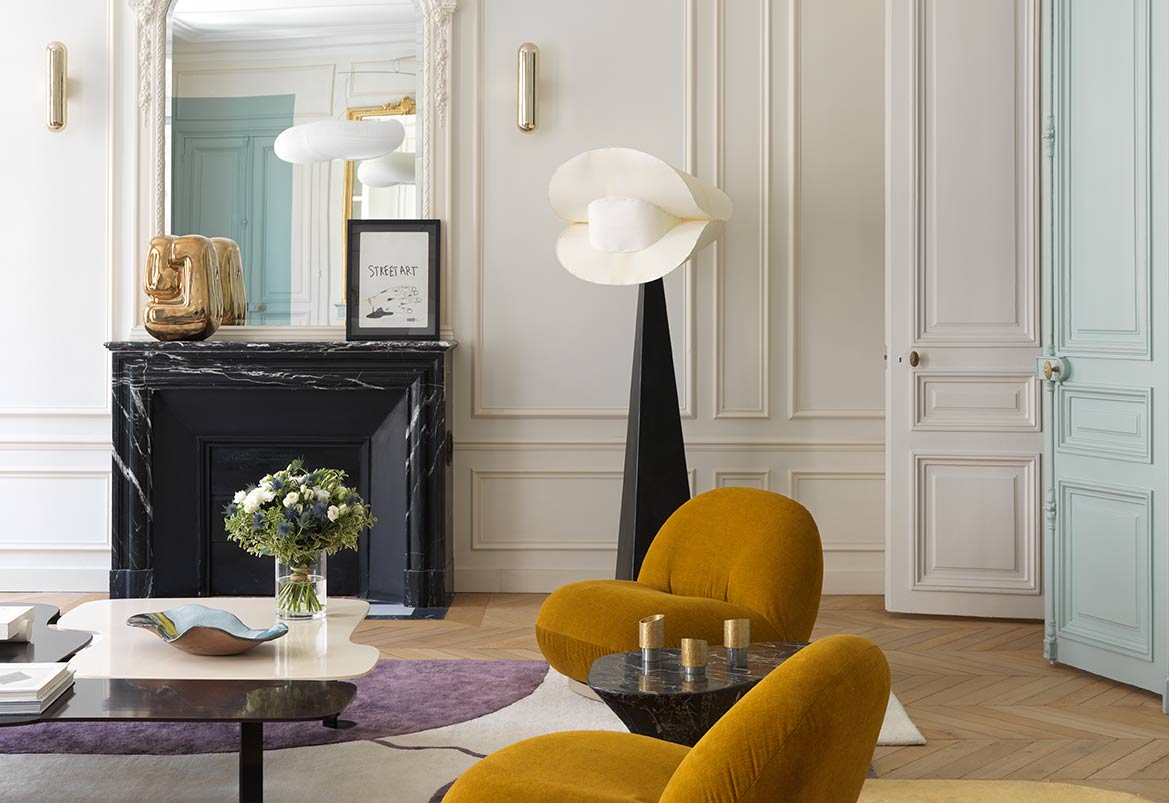
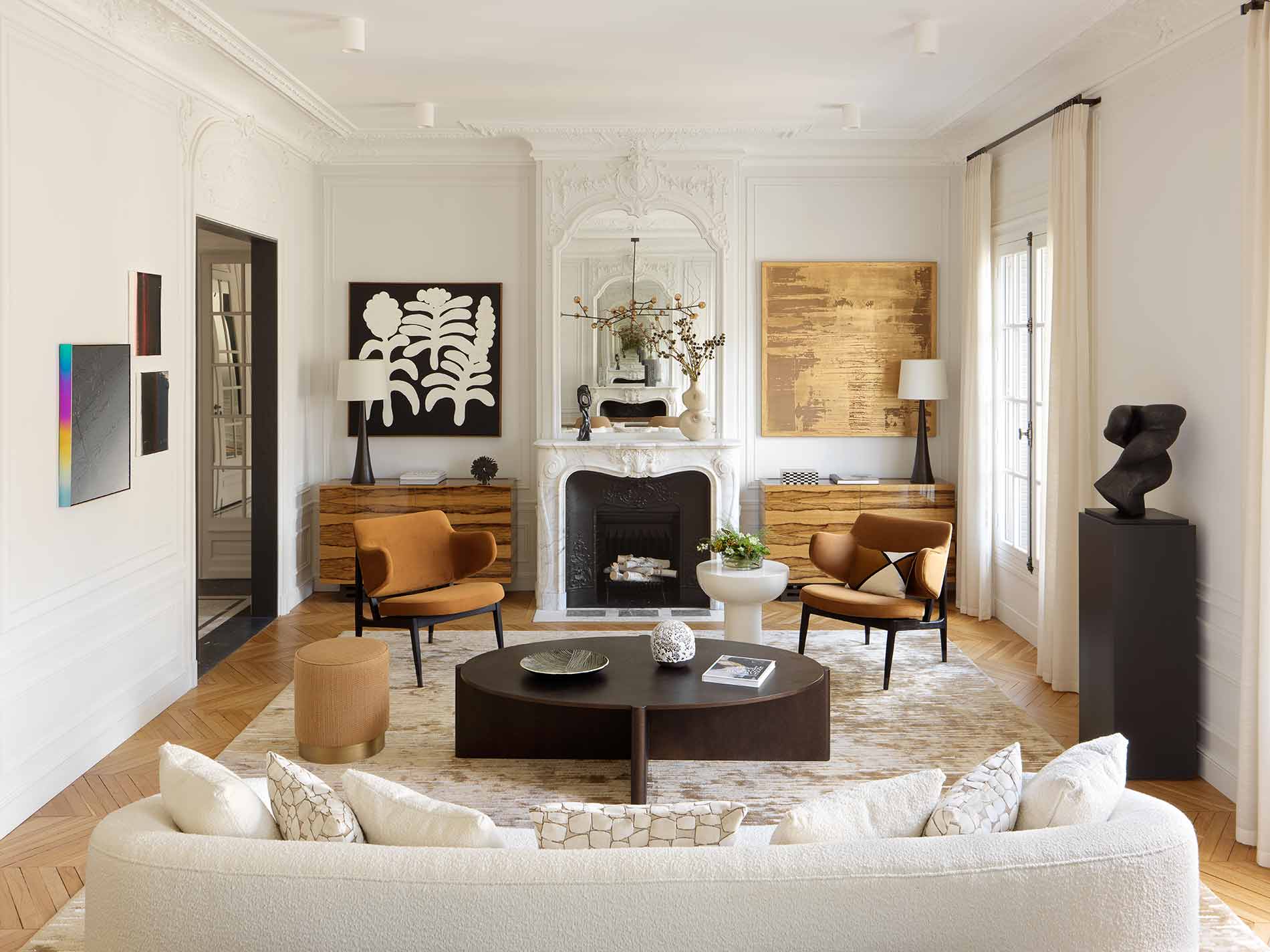
An antique fireplace has never been merely a source of heat. From its origins in aristocratic residences and elegant period homes, it has held a central place in interior architecture, serving as a focal point that reflected the status, culture, and aesthetic taste of its time.
Over the centuries, fireplace mantels have evolved alongside the major movements in art and architecture. In this article, we explore almost two centuries of design: from the graceful curves of Louis XV to the essential, revolutionary geometry of Art Deco, examining the distinctive features that define these authentic antique fireplaces, today highly sought after by collectors and enthusiasts of high-end interior design.
Style and period of production: a note on authenticity
Before examining each individual style, it is important to make a fundamental distinction: the style of a fireplace does not necessarily correspond to the period in which the monarch after whom it was named actually reigned.
While some 20th-century styles, such as Art Deco, were confined to a more specific period, the great classical styles — particularly Louis XV and Louis XVI — continued to be reinterpreted and produced long after they first emerged, throughout the 19th century and, in some cases, into the early decades of the 20th century.
The same applies to the Louis Philippe style, which originated in the 1830s and remained widely popular in the decades that followed.
Describing a fireplace as “Louis XVI style” therefore refers to its decorative and formal language, not necessarily to the date when it was made. A piece carved in the second half of the 19th century can be an entirely authentic antique fireplace, even though its design is rooted in a stylistic tradition that originated in the previous century.
1. The Louis XV style: 18th-century origins and the enduring success of Rococo
Under Louis XV, the fireplace became an increasingly refined expression of grace and lightness. During his reign in France, the style known as Rococo emerged, gradually moving away from the monumentality and strict symmetry of the preceding Louis XIV period in favor of freer, more sinuous, and dynamic forms.
Louis XV fireplace design moves away from straight lines in favor of flowing forms, controlled asymmetry, and decorative motifs inspired by nature.
Key features to look for:
- The “Arbalète” (crossbow) line: rather than following a straight line, the frieze of the mantel forms a distinctive sinuous double curve reminiscent of the shape of a crossbow;
- “Pied Galbé” jambs: the side jambs of the fireplace do not descend perpendicular to the floor but feature a distinctive curved profile (galbé), giving the entire structure a sense of height and continuity;
- Decorative motifs (shells and roses): the coquille is one of the most characteristic motifs of the Louis XV style, often paired with floral compositions, roses, leaves, and other nature-inspired elements. Celebrated models such as the Pompadour, whose name evokes the figure and taste of Madame de Pompadour, perfectly embody this refined aesthetic. White Carrara and Statuario marble, along with the many polychrome marbles used during this period, further enhance the richness of these forms.
Stone fireplaces: a material alternative
While white marble remained the material of choice for the grand reception rooms of Parisian residences, the Louis XV style also found elegant expression in stone fireplaces. Used primarily in country houses, provincial residences, or less formal interiors, fireplaces made of limestone or sandstone reinterpreted the sinuous lines of Rococo with a warmer, more natural character.
Softer and easier to carve than marble, stone allowed the craftsmen of the period to create gentle curves, arbalète lines, and central shell motifs with a more rustic character, without sacrificing the refinement of the design. Choosing a Louis XV stone fireplace today means introducing an authentic antique piece that combines the elegance of 18th-century proportions with the natural character of stone, making it equally well suited to rustic-chic or contemporary farmhouse interiors.
2. The Louis XVI style: Neoclassicism beyond the reign of Louis XVI
The rediscovery of classical antiquity, encouraged throughout the 18th century in part by the archaeological excavations of Herculaneum and Pompeii, gradually transformed European aesthetic sensibilities. The free and asymmetrical forms of Rococo gave way to a renewed interest in order, symmetry, and the decorative vocabulary of antiquity, giving rise to Neoclassicism.
The Louis XVI fireplace gradually moves away from the sinuous forms of the Louis XV style, returning instead to order, symmetry, and geometric rigor.

Key features to look for:
- The return to straight lines: the frieze of the mantel generally follows a horizontal line, while the jambs become straight and regular, reflecting the order and symmetry of classical architecture;
- Fluted jambs: the side jambs often recall the columns and pilasters of Greek and Roman architecture, with vertical fluting (cannelures) that emphasizes the verticality of the structure;
- Geometric and classical details: the free-flowing forms of Rococo give way to a decorative vocabulary inspired by classical antiquity, including symmetrical rosettes, laurel garlands, ribbons and love knots, triglyphs, and Greek key motifs. The overall composition becomes more orderly and symmetrical, with a clearly defined geometric structure.
Read our case study on the restoration of a Louis XIV fireplace for a historic residence in London
3. The 19th century: Empire, Louis Philippe, and the great revival of historic styles
The 19th century was a period of major political and economic change, with a profound influence on interior design.
The century began with the Empire style, which developed during the Napoleonic era and drew heavily on the monumentality of classical antiquity. Fireplaces took on imposing, architectural forms, with predominantly rectilinear structures and a rich decorative vocabulary: sphinxes, imperial eagles, palmettes, winged victories, and Greco-Roman motifs, sometimes enriched with gilt-bronze details.
By the middle of the century, with the growing prominence of the bourgeoisie during the reign of Louis Philippe (1830–1848), tastes in interior design were also changing. The monumental, ceremonial character of the Empire style gradually gave way to a preference for greater restraint, functionality, and domestic comfort. With its simpler forms and ability to adapt naturally to residential interiors, the Louis Philippe fireplace became extremely popular in 19th-century homes.
Key features of the Louis Philippe style:
- The “cushion” profile (rounded upper corners): the upper corners of the fireplace are rounded, creating a soft, continuous transition between the frieze and the jambs. This is one of the most recognizable features of many Louis Philippe fireplaces;
- Simplicity and warmth: compared with the decorative richness of the Empire style, Louis Philippe favors cleaner, more understated lines, making these fireplaces remarkably versatile. Decoration takes a back seat to the beauty of the material itself, whether white marble or the many veined and polychrome varieties used throughout the 19th century.
Empire Style fireplaces | Louis Philippe fireplaces
4. Art Deco (1920–1939): the revolution of modernity
Following the floral language of Art Nouveau — known as Liberty in Italy — the 1920s and 1930s introduced a radically new aesthetic. It was the age of speed, New York skyscrapers, automobiles, and industrial production. Art Decoreimagined decoration through geometry, symmetry, fine materials, and bold color contrasts.
The Art Deco fireplace took on a distinctly architectural character: clean volumes, bold proportions, and geometric surfaces were combined with carefully selected marbles and decorative inlays, reflecting the aesthetic of the modern home.
Key features to look for:
- Angular geometry and stepped forms: naturalistic decoration gives way to more stylized, geometric forms. The fireplace is defined by squared volumes, strong vertical lines, strict symmetry, and stepped profiles, sometimes inspired by the form of a ziggurat;
- Bold color contrasts: Art Deco favors combinations of different materials and colors. Black, red, green, or cream marbles may be combined with one another or paired with metal details, mirrors, and glass, transforming the fireplace surround into a decorative composition in its own right;
- Material and geometry: decoration often emerges from the strength of the volumes, the quality and veining of the marble, color contrasts, and the precision of geometric cuts. Marble is no longer simply a construction material; it becomes an integral part of the design through the careful selection and arrangement of different colors, veining, and varieties.
The value of authenticity: why choose a certified antique piece
Introducing an antique fireplace into a contemporary interior — whether a sinuous Louis XV or a geometric Art Deco piece — gives the space a distinctive character.
However, buying antiques requires expertise. When considering the purchase of an antique fireplace mantel, it is essential to work with specialists who can assess and document its authenticity based on tangible evidence: from the type and age of the marble to traces of historic hand craftsmanship on the backs of the slabs, as well as the surface wear and patina that have developed naturally over time.
Whether placed in a traditional living room or used as a striking contrast in a minimalist interior, an antique fireplacebecomes more than a decorative object: it becomes a fragment of history that continues to bring warmth and character to the space.
FAQ about Louis XV and Art Deco
What is the Louis XV style called?
The Louis XV style is closely associated with Rococo and the rocaille aesthetic, characterized by curved, sinuous lines, often asymmetrical compositions, and decorative motifs inspired by nature, such as shells, leaves, and flowers.
What is the Louis Philippe style?
The Louis Philippe style emerged in France during the reign of Louis Philippe (1830–1848) and favors more restrained forms and cleaner lines than the styles that preceded it. In fireplace design, it can be recognized by simple, understated forms and the characteristic rounded upper corners found on many Louis Philippe mantels.
How can I be sure that an antique fireplace is authentic?
Authenticity is assessed through several factors: the type and age of the marble, construction techniques, traces of hand craftsmanship, and the patina and surface wear that have developed naturally over time. One of the most significant indicators is the quality of the carving: its refinement and richness of detail reveal a level of craftsmanship, as well as the considerable time required to produce it, that would be difficult to replicate today. Our antique fireplaces are supplied with a Certificate of Authenticity.
Can an antique fireplace be adapted to a modern pellet or bioethanol firebox?
Absolutely. Our antique fireplace mantels are supplied ready for installation and can be adapted to frame bioethanol burners, pellet units, or modern high-efficiency wood-burning inserts.
Do you restore fireplaces owned by customers?
No. Restoration is one of our specialties, but we carry it out exclusively in our own workshops and only on pieces from our collection, which are professionally restored and delivered ready for installation.
Why does a Louis XV or Louis XVI style fireplace often date from the 19th century?
Because the great classical styles continued to be appreciated and reinterpreted long after the periods in which they originated. Between 1860 and 1880 in particular, the production of Louis XV and Louis XVI style fireplaces experienced one of its most prolific periods, producing pieces of exceptional craftsmanship and sculptural quality. A fireplace made during this period is therefore an authentic antique fireplace in every respect, even though its stylistic language originated in the 18th century.